SV-Gap documentation
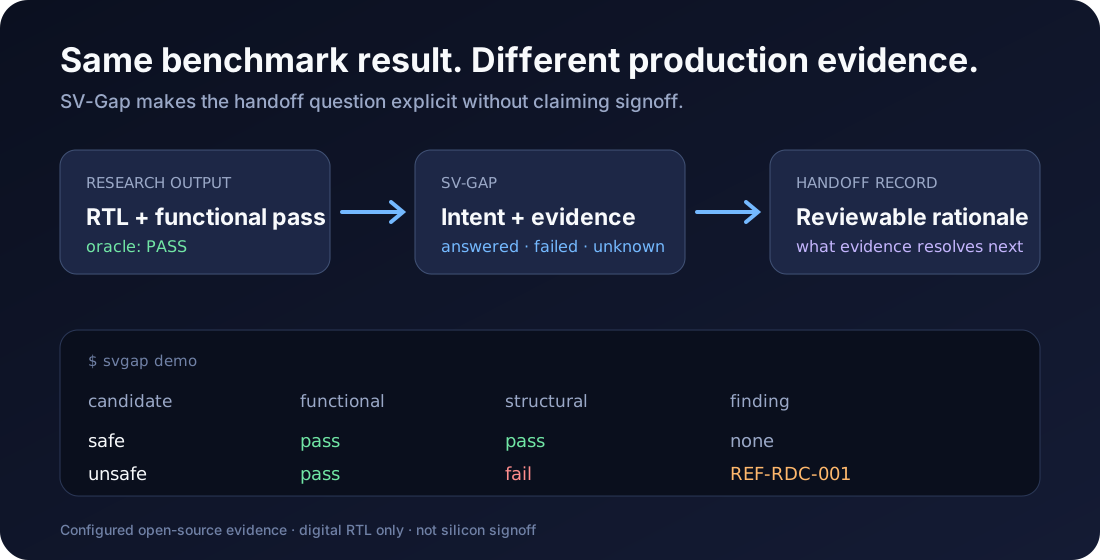
SV-Gap makes the gap between “passes the benchmark” and “reviewable by a chip-design team” explicit for AI-generated digital RTL: LLM-written Verilog and SystemVerilog, evaluated against declared design intent for clock-domain crossing (CDC), reset-domain crossing (RDC), synchronizer depth, X behavior, power-on state, temporal/protocol behavior, and synthesized equivalence. Schema v2 retains each evidence class separately without conflating coverage.
Start here
- Name one production question your functional eval leaves unanswered (60 seconds, no install)
- Inspect the controlled result without installing anything
- Create and interpret a local evidence profile
- Run one packaged model-evaluation task
- Run or report the eight-task Harbor experiment
- Bring your own RTL
- Integrate an existing benchmark
- Study frontier-model handoff capability
- Request a research scoping call or email the maintainer
- Explore the design-partner workflow
Trust boundary
SV-Gap runs locally and performs no telemetry or artifact uploads. Generated RTL and functional commands are untrusted input; use the network-disabled evaluation workflow for outputs you have not reviewed. Results are bounded evidence profiles, not certification or silicon signoff.
Copy-paste JSON demo
Use --json with --output when a CI job, issue, or agent benchmark needs a
machine-readable first result and a preserved reproducer:
svgap demo --json --output demo-output \
  | jq '{status, safe: .safe.structural, unsafe: .unsafe.structural, findings: .unsafe.findings}'
{
  "findings": [
    "REF-RDC-001"
  ],
  "safe": "pass",
  "status": "pass",
  "unsafe": "fail"
}
Attach demo-output/summary.json, both */build/report.json files, and the
preserved manifests/RTL sources when filing an issue or publishing a CI
artifact. Do not commit demo-output; it is generated evidence.
Claim boundary: this controlled witness shows that the supplied functional oracle does not identify the structural reset-release finding. It is not a defect-rate estimate or silicon signoff.
Build the ecosystem
- See the current research collaboration pulse
- Choose a research collaboration path
- Write a checker backend
- Understand the architecture
- Review the scope boundary
- Contribute