Reset-release replication v0.1
Run date: 2026-07-02
Result
The locally frozen study generated 72 candidates from eight reset-sensitive tasks, three exact model configurations, and three separate calls per model-task cell. No candidate was repaired. Model tools were disabled.
| Outcome | Count |
|---|---|
| Planned and generated | 72 |
| Functional pass | 57 |
| Functional compile/elaboration error | 6 |
| Functional behavioral-test fail | 9 |
| Structural pass | 57 |
| Structural fail | 15 |
| Structural tool error | 0 |
| Functional pass + structural fail | 14 |
The configured detector marked 14/57 = 24.6% of functionally accepted,
structurally determinate candidates. This is an automated detection fraction,
not a validated defect rate: the authoring-session inspection confirmed every
flagged candidate, but no independent reviewer has yet labeled the 43 detected
passes for false negatives.
Fifteen structural-fail candidates were manually inspected. All 15 contain the reported pattern; 14 are in the functional-pass denominator. One additional structural failure belongs to a candidate that did not elaborate under Icarus. This first review is recorded, but independent expert adjudication remains required before submission.
Blinded synthetic robustness check
Four reviewer configurations not used for candidate generation independently
labeled all 72 cases twice under secret-keyed identifiers, alongside 12 hidden
calibration controls per repeat. Seven repeat panels scored 12/12 calibration;
one scored 11/12. Exact within-configuration target agreement was 72/72 for
three configurations and 71/72 for the fourth. Nominal Krippendorff alpha over
all eight repeat panels was 0.989.
Under the prespecified conservative consensus rule, the panel labeled 15/72
targets yes and 57/72 no, with zero unresolved. Among the 57 functional
passes, consensus was 14 yes and 43 no. This matches the reference oracle on
all 72 cases. It is a strong reproducibility check on the structural distinction,
but synthetic reviewers are not independent human CDC/RDC experts and cannot
establish false-negative recall outside this frozen taskpack. See the full
synthetic result.
Task replication
Detected cases appeared in five of eight hand-authored tasks:
| Task | Functional passes | Gap members |
|---|---|---|
| Counter | 9 | 6 |
| Credit counter | 9 | 3 |
| FSM | 3 | 1 |
| Status latch | 8 | 2 |
| Watchdog | 9 | 2 |
| Configuration register | 9 | 0 |
| Event counter | 9 | 0 |
| Timer | 1 | 0 |
This grouping is more informative than treating 72 calls as independent replications. The result demonstrates recurrence across several interfaces, but eight hand-authored tasks are not a representative population.
Task-clustered sensitivity interval
A 100,000-replicate nonparametric bootstrap resamples whole tasks while
retaining all candidates within each sampled task. The candidate-weighted point
estimate is 14/57 = 24.6% and the 95% percentile interval is 8.8% to
42.9% (seed 20260824).
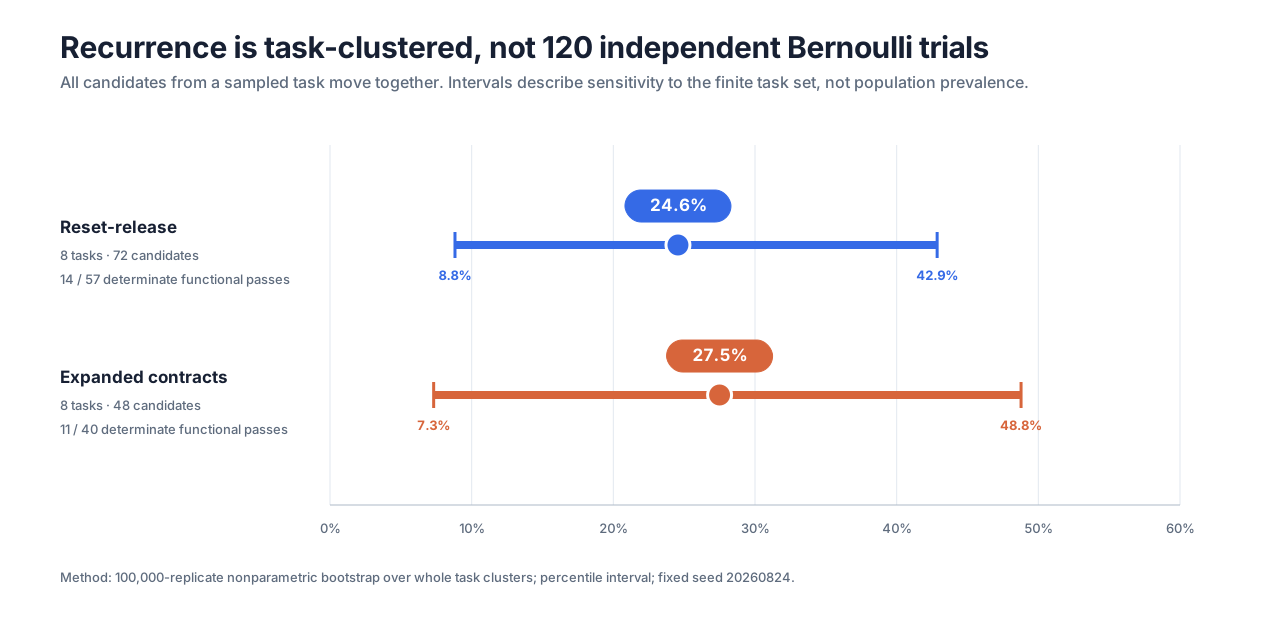
This is a finite-task sensitivity analysis, not a population-prevalence
confidence interval. The frozen machine-readable result is
reports/reset-replication-v0.1-clustered.json.
Measurement caveats
Six functional nonpasses are Icarus elaboration errors on enum-valued ternary
expressions. Eight are timer-test failures. After generation, review found that
the timer prompt did not define the reset value of expired, while its testbench
assumed zero. The frozen result is preserved above; a transparent sensitivity
analysis excluding the whole timer task gives 14/56 = 25.0%, leaving the
conclusion unchanged. The remaining functional failure correctly detects a
status register that does not assert reset asynchronously.
Per-model descriptive fractions range from 1/17 to 7/19, but this study is
not powered or balanced for model ranking: functional denominators differ,
samples share tasks, and only two model vendors are represented.
Defensible claim
In the locally archived 72-call reset taskpack, 57 outputs passed the supplied Icarus testbenches, and at least 14 of those 57 contain a directly inspectable raw asynchronous-reset connection to ordinary operational state despite the prompt requesting synchronized release.
This is a taskpack-conditional lower-bound detection count. It is not an estimate of all generated RTL, proof of silicon failure, a validated 24.6% defect rate, or evidence that the reference oracle is signoff-grade.
One qualitative pattern in the detected cases is worth stating because it is
directly checkable: every one of the 14 detected cases also contains a
two-flop reset synchronizer that the reference oracle recognizes in the same
design, so the raw asynchronous reset reaches operational state past a
synchronizer the model itself built. Cases from all three configurations show
the pattern. The synchronizer output is not left dangling either: in all 14
cases it feeds only synchronous data-path logic (a mux select, typically a
synchronous clear or qualifier on D), and in no case does it drive the
asynchronous reset pin of a flagged register, which stays on the raw net.
Recovery and removal timing constrain the asynchronous pin, so the
synchronous use does not change the hazard.
python scripts/verify_synchronizer_bypass.py recomputes both the
per-configuration counts and the consumer roles from the frozen artifact.
Recompute the clustered analysis with:
.venv/bin/python scripts/analyze_clustered_results.py \
  artifacts/reset-replication-v0.1/candidates \
  --output reports/reset-replication-v0.1-clustered.json