Expanded contract-oracle generation study v0.1
Run date: 2026-08-24 Pacific time
Taskpack freeze: sha256:937bd8fe1297c89b279492700a25684fd4f5d37d510a27059cb9905b66981bff
Result
SV-Gap generated 48 fresh, unrepaired RTL candidates across eight task clusters, three exact model configurations, and two calls per model-task cell. The tasks exercise ready/valid persistence, bounded response, one-cycle pulse width, and synthesized-reference equivalence. Each candidate was evaluated by an Icarus functional smoke test, one contributing specialized oracle, and contextual Verilator lint.
| Outcome | Count |
|---|---|
| Planned and generated | 48 |
| Functional pass | 41 |
| Functional behavioral-test fail | 5 |
| Functional compile/elaboration error | 2 |
| Contributing-oracle pass | 32 |
| Contributing-oracle fail | 12 |
| Contributing-oracle tool error | 4 |
| Functional pass + determinate contributing oracle | 40 |
| Functional pass + contributing-oracle fail | 11 |
The configured specialized oracles changed the outcome for
11/40 = 27.5% of functionally accepted candidates with a determinate
specialized result. This is a taskpack-conditional automated detection
fraction, not an estimate of defects in generated RTL generally.
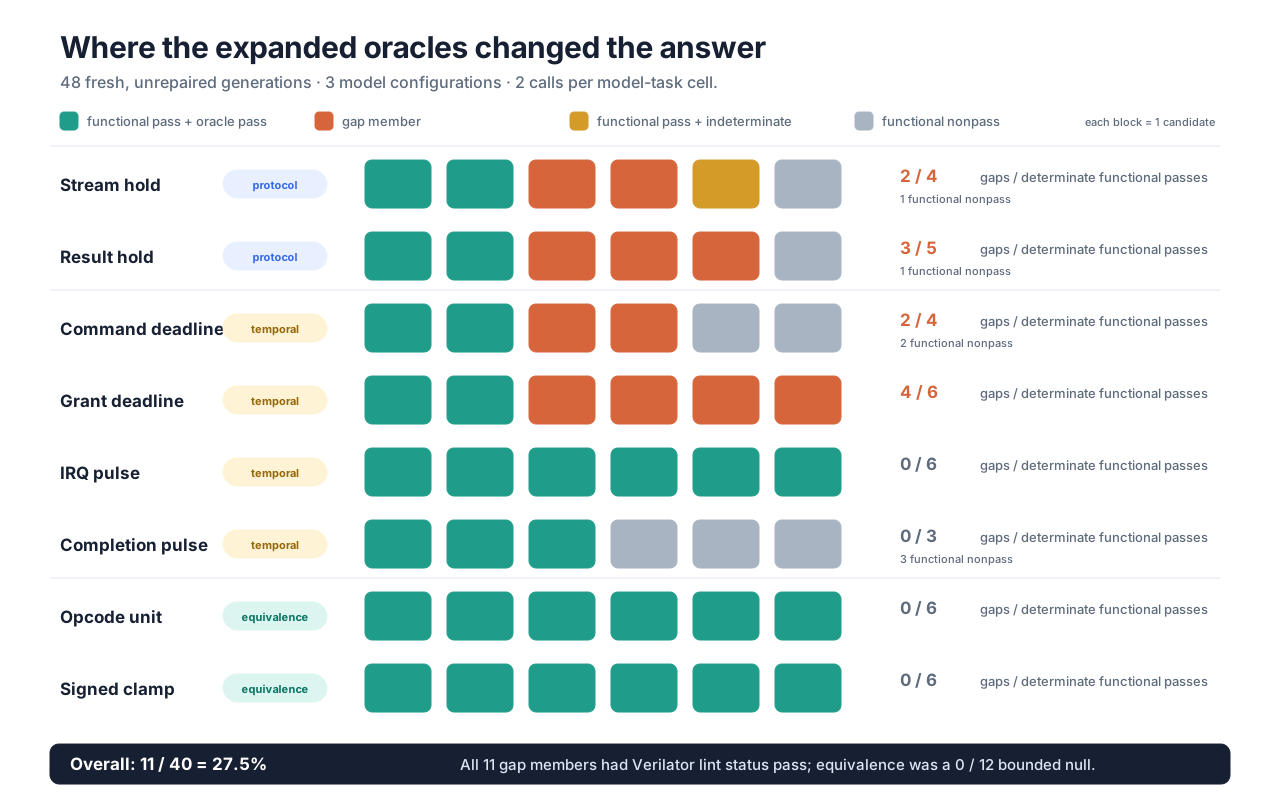
Result by oracle class
| Class | Tasks | Candidates | Functional pass | Determinate functional pass | Gap members |
|---|---|---|---|---|---|
| Protocol persistence | 2 | 12 | 10 | 9 | 5 |
| Temporal response and pulse | 4 | 24 | 19 | 19 | 6 |
| Synthesized-reference equivalence | 2 | 12 | 12 | 12 | 0 |
| Total | 8 | 48 | 41 | 40 | 11 |
The equivalence stratum is a bounded null result: all 12 candidates passed the finite functional harness and the synthesized-reference miter. This does not show that generated RTL is generally safe under synthesis semantics; it says these two tasks and 12 outputs produced no detected divergence.
The protocol and temporal findings are directly inspectable counterexamples:
REF-PROT-001: valid or payload did not persist through backpressure;REF-TEMP-001: a required response missed its bounded deadline; andREF-TEMP-002: a required one-cycle pulse had the wrong width.
Result by task cluster
| Task | Class | Functional passes | Determinate functional passes | Gap members |
|---|---|---|---|---|
| Stream hold | Protocol | 5 | 4 | 2 |
| Result hold | Protocol | 5 | 5 | 3 |
| Command deadline | Temporal | 4 | 4 | 2 |
| Grant deadline | Temporal | 6 | 6 | 4 |
| IRQ pulse | Temporal | 6 | 6 | 0 |
| Completion pulse | Temporal | 3 | 3 | 0 |
| Opcode unit | Equivalence | 6 | 6 | 0 |
| Signed clamp | Equivalence | 6 | 6 | 0 |
Detected cases recur in four of eight tasks and in both protocol and temporal classes. The other four tasks are bounded zero rows, not evidence that their contract class is solved.
Task-clustered sensitivity analysis
Treating 48 calls as independent observations would overstate replication
because candidates share prompts, harnesses, and properties. A nonparametric
bootstrap resamples all candidates belonging to a task together.
With 100,000 replicates and seed 20260824, the candidate-weighted estimate is
27.5% and the 95% percentile interval is 7.3% to 48.8%.
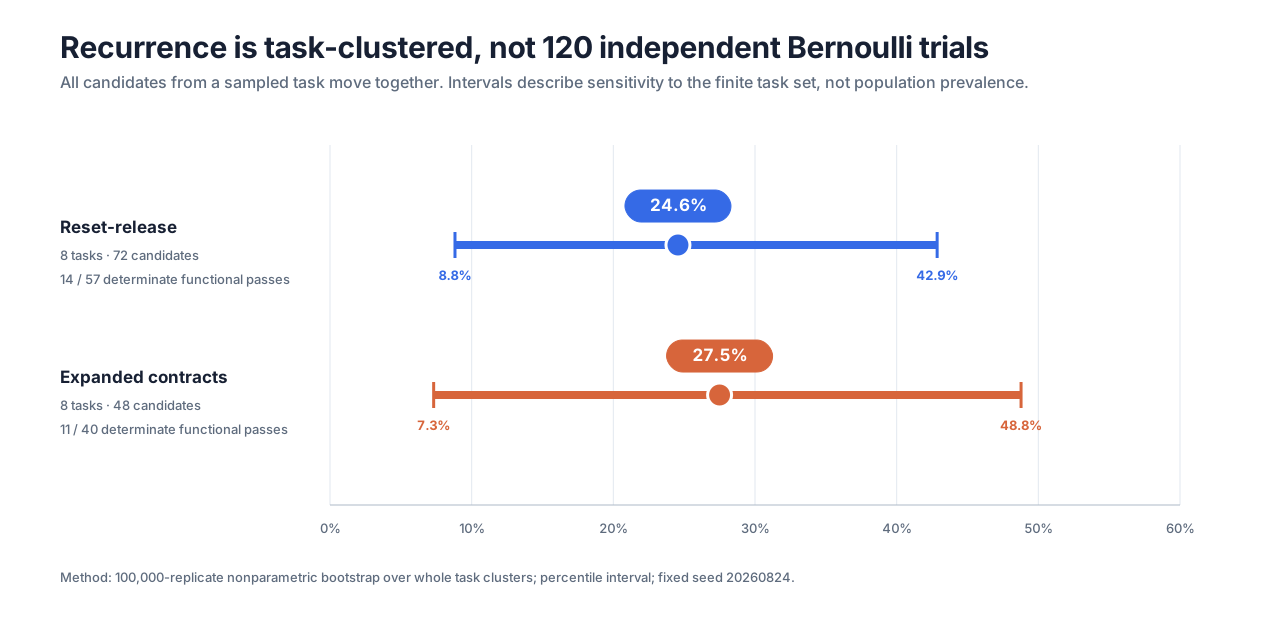
This is a finite-task sensitivity interval. The eight tasks were hand-authored,
not randomly sampled from a defined population, so the interval must not be
reported as a population-prevalence confidence interval. The machine-readable
analysis is
reports/contract-oracles-v0.1-clustered.json.
Ordinary lint result
All 11 gap members have Verilator lint status pass. Ten have no lint finding.
One has an unrelated unused-signal warning; it does not identify the protocol
violation. Therefore ordinary RTL lint identified 0/11 specialized failures
in this study.
This is an empirical result for the exact candidates and Verilator configuration, not a general recall estimate for all linters. Lint still serves important production purposes: style enforcement, suspicious construct and width checks, portability checks, dead-code signals, and fast pre-simulation feedback. It simply answers a different question from an explicit temporal or equivalence obligation.
Model configurations
| Configuration label | Provider interface | Candidates | Functional passes | Determinate passes | Gap members |
|---|---|---|---|---|---|
gpt-5.6-sol |
Codex CLI 0.145.0-alpha.2 |
16 | 16 | 16 | 0 |
qwen2.5-coder-7b |
Ollama 0.31.1 |
16 | 14 | 14 | 8 |
deepseek-coder-v2-16b |
Ollama 0.31.1 |
16 | 11 | 10 | 3 |
The Ollama calls used temperature 0.2, non-streaming generation, and seeds
2026082401 and 2026082402. These per-configuration outcomes are descriptive
only. Two calls per task, unequal functional denominators, and eight
hand-authored tasks do not support a model ranking.
Study controls and excluded pilot
- Task prompts, support files, manifests, safe/unsafe calibration references, and the canonical taskpack digest were frozen before the sequential primary run.
- Every safe and unsafe reference passed its finite functional harness; every safe reference passed its specialized oracle; every unsafe reference failed the intended stable rule.
- Candidates were generated in fresh calls and were not repaired.
- Claude CLI authentication was unavailable, so the frozen three-configuration design used one hosted configuration and two local open-weight configurations.
- An earlier interface pilot attempted to load the two Ollama models concurrently. It produced HTTP 500 generation failures and disrupted the hosted CLI network sandbox. The pilot was stopped and is excluded in full; no pilot candidate enters the 48 reported outputs.
The freeze is a local prospective freeze with a content digest. It was not externally timestamped or preregistered, and there is not yet independent human review of the 48 new candidates.
Reproduction and public artifact
The public artifact contains all 48 candidate bundles: prompt, normalized RTL,
testbench, property or reference, manifest, report, generation metadata,
selected formal evidence, provenance hashes, a candidate outcome index, and
the clustered analysis. It is available under
artifacts/contract-oracle-study-v0.1/.
Verify every file hash, portable path, indexed outcome, report schema, and the 100,000-replicate analysis with:
.venv/bin/python scripts/verify_contract_oracle_artifacts.py
Replay an individual candidate with:
svgap check artifacts/contract-oracle-study-v0.1/candidates/<run>/<task>/manifest.toml
Rebuild the figures from the frozen JSON with:
.venv/bin/python scripts/build_research_figures.py
Defensible claim
In a locally frozen study of 48 fresh, unrepaired outputs over eight hand-authored protocol, temporal, and synthesis-equivalence tasks, 41 outputs passed the supplied finite smoke tests. Forty received a determinate contributing-oracle result, and 11 of those 40 failed the task's explicit protocol or temporal property. Verilator lint did not identify any of the 11 specialized failures. Both equivalence tasks produced bounded null results.
Do not restate this as a 27.5% defect rate for a model population, a signoff result, proof that ordinary lint never detects these classes, or evidence that equivalence failures are rare. Broader task sampling, more calls, independent expert adjudication, and industrial oracle replication remain necessary.